

Enterprise technology today moves faster than procurement frameworks were ever designed to handle. Hardware refresh cycles are shortening, compliance requirements are expanding, and organizations are under increasing pressure to account for every device from acquisition to retirement.
Within this environment, structured lifecycle management has become a governance function rather than a background IT task, especially when engaging with IT asset disposition companies in Dubai for regulated end-stage handling.
Effective lifecycle control is not only about deploying the right systems at the right time. It also involves knowing precisely when technology should exit active use, how residual data is managed, and how retired assets are processed without exposing the organization to regulatory or reputational risk.
Secure end-stage controls form the final, and often most scrutinized, phase of enterprise technology management.
Understanding the Full Technology Lifecycle in Enterprise Environments
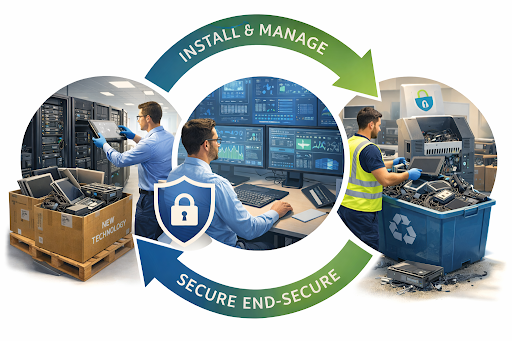
Enterprise technology lifecycles extend far beyond installation and operational use. Each asset passes through procurement, deployment, utilization, maintenance, reassignment, and eventual retirement. Managing these stages cohesively allows organizations to forecast costs accurately and reduce operational friction across departments.
When lifecycle oversight is fragmented, end-stage risks multiply. Assets may be decommissioned inconsistently, data may remain accessible, and audit trails may become incomplete. A lifecycle-centered approach ensures that retirement planning is considered as early as the acquisition stage, creating a closed-loop system that supports accountability.
Risk Exposure at the End of the Technology Lifecycle
The end-stage of an IT asset’s life is where risk concentrates most sharply. Devices leaving active use often still contain sensitive corporate, financial, or personal data. Without controlled processes, this data can remain recoverable long after the asset is removed from service.
Additionally, regulatory obligations related to data protection, environmental responsibility, and record retention converge at this phase. Enterprises that fail to address these requirements holistically expose themselves to penalties and reputational damage, even if earlier lifecycle stages were well managed.
Secure Decommissioning as a Governance Requirement
Secure decommissioning has evolved into a governance requirement rather than an operational preference. Boards and compliance teams increasingly demand visibility into how retired assets are handled, documented, and verified.
This shift reflects a broader understanding that data risk does not end when a device is powered down. Secure decommissioning integrates technical controls with documentation standards, ensuring that every retired asset can be traced, verified, and defended during audits or investigations.
Data Sanitization and Verification Protocols
Data sanitization is the technical backbone of secure end-stage controls. It involves applying validated processes to permanently remove data from storage media so that recovery is no longer feasible.
Verification is equally important. Sanitization without confirmation creates blind spots. Robust protocols include logging, certification, and independent validation steps that allow enterprises to demonstrate compliance rather than merely claim it.
Asset Tracking and Chain of Custody
Maintaining an unbroken chain of custody ensures that assets are accounted for from the moment they exit active use until final processing. This tracking prevents loss, unauthorized access, and undocumented handling.
Detailed asset logs, transfer records, and reconciliation reports provide assurance that devices have not been diverted or mishandled. For enterprises operating across multiple locations, standardized chain-of-custody practices are essential for consistency and control.
Compliance Documentation and Audit Readiness
Regulators and auditors increasingly expect enterprises to produce evidence of secure asset retirement. Documentation must demonstrate not only what actions were taken, but when, how, and by whom.
Audit-ready processes reduce the burden of reactive reporting. When documentation is embedded into lifecycle management, compliance becomes a continuous state rather than a periodic scramble.
Environmental Responsibility in Technology Retirement
Beyond data security, end-stage controls carry environmental implications. Electronic waste contains materials that require specialized handling to prevent environmental harm and comply with sustainability regulations.
Enterprises are now expected to consider environmental outcomes as part of their technology governance. Responsible processing aligns corporate sustainability commitments with operational reality, reducing landfill impact and supporting circular economy principles.
Integration with Enterprise IT and Security Frameworks
Secure end-stage controls cannot operate in isolation. They must integrate with broader IT asset management, information security, and risk frameworks to be effective.
Alignment ensures that retirement triggers are recognized within systems, approvals follow defined workflows, and reporting aligns with enterprise metrics. Integration also supports better forecasting and budgeting by providing visibility into asset lifespan and replacement cycles.
Policy Alignment Across Departments
Technology retirement often touches multiple departments, including IT, security, legal, finance, and sustainability teams. Misalignment between these groups creates gaps and delays.
Clear policies that define roles, responsibilities, and escalation paths help maintain momentum and accountability. When departments operate from a shared framework, end-stage controls become predictable and repeatable.
Secure Logistics and Handling Controls
Physical handling of retired assets introduces its own set of risks. Devices in transit are vulnerable to loss or tampering if logistics controls are weak.
Secure handling protocols include sealed transport, controlled access points, and documented transfers. These measures ensure that physical security supports digital security objectives throughout the retirement process.
Reporting and Transparency for Stakeholders
Transparent reporting builds trust with internal and external stakeholders. Executives, auditors, and regulators all benefit from clear summaries that demonstrate responsible asset retirement.
Structured reports that consolidate technical actions, compliance outcomes, and environmental metrics provide a comprehensive view of end-stage performance without overwhelming detail.
Measuring Effectiveness of End-Stage Controls
What cannot be measured cannot be improved. Enterprises should define clear metrics to evaluate the effectiveness of their end-stage controls.
These may include asset reconciliation rates, documentation completeness, audit outcomes, and incident reduction. Over time, metrics reveal trends that inform process refinement and risk mitigation strategies.
Preparing for Future Regulatory and Technology Shifts
Regulatory landscapes continue to evolve, and emerging technologies introduce new retirement challenges. Cloud-integrated hardware, embedded storage, and distributed devices complicate traditional end-stage models.
Forward-looking enterprises anticipate these changes by designing flexible frameworks. Adaptability ensures that end-stage controls remain effective even as technology architectures and compliance expectations shift.
Final Thoughts on Structured Technology Retirement
Managing enterprise technology lifecycles requires discipline, foresight, and consistency, particularly at the point where assets exit operational use. Secure end-stage controls protect data, support compliance, and reinforce environmental responsibility when executed as part of a unified governance strategy.
Organizations seeking structured and compliant disposal of IT equipment in Dubai increasingly look to specialized service providers that align with enterprise standards. Planet Green Recycling operates within this space by supporting controlled retirement processes that reflect regulatory, security, and sustainability considerations without disrupting core business operations.